
Dry Liningin Teddington
Residential dry lining with the background, preparation and practical details considered together. Speak to Liam Cooper about plasterboard linings for suitable residential walls and ceilings and request a free no-obligation quote.
Almost 10 years
In the trade
£1m Insured
Public liability cover
Written Guarantee
Ask Liam for the terms
Owner-Led
Managed by Liam
Free Quotes
No obligation
The service
Dry Lining planned around your home
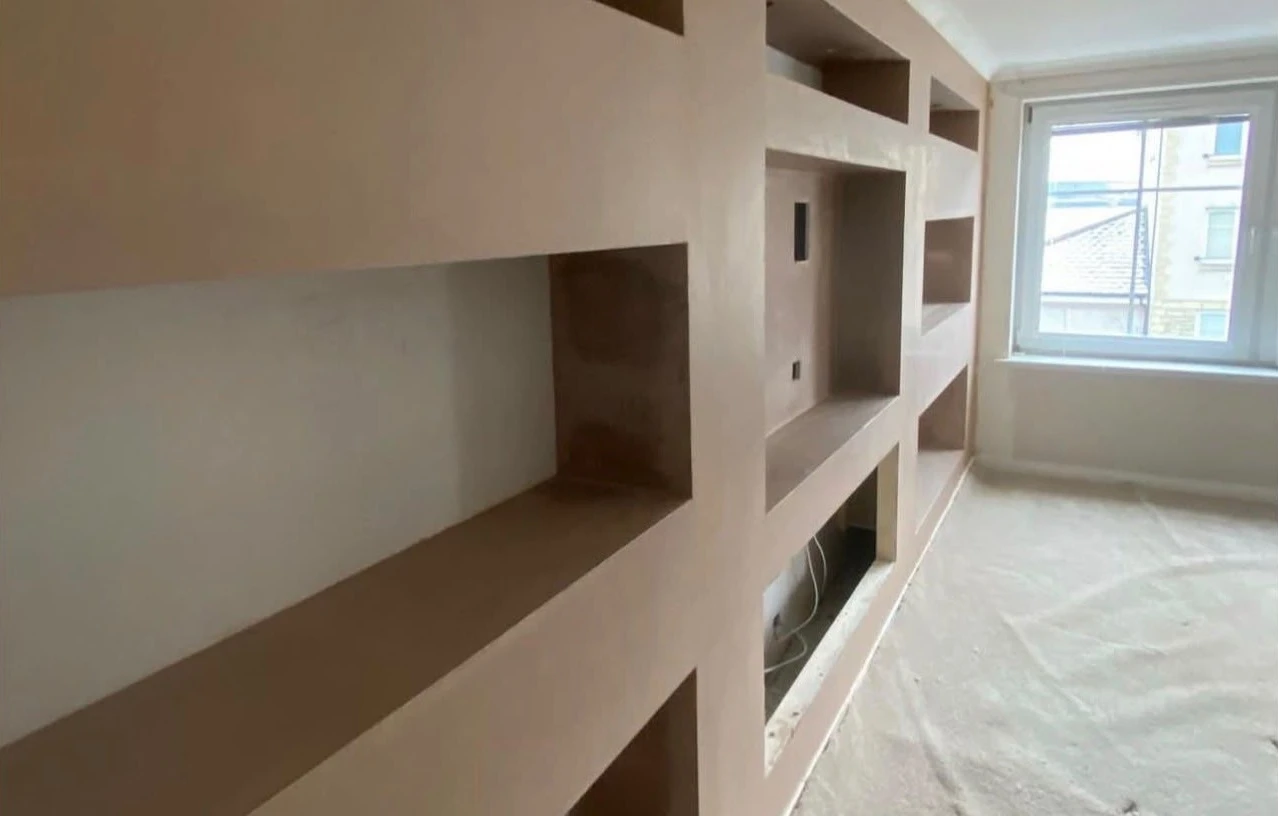
Dry lining creates an internal surface using plasterboard rather than relying solely on a wet plaster build-up. It can be relevant where a wall needs a new lining, damaged board needs replacing or a ceiling needs a suitable boarded background. Coopers Interiors discusses the existing construction and desired result before proposing how the boards should be supported and finished.
The important decision is not simply which board to buy. Fixings, background condition, junctions, services and the final treatment all affect the finished surface. Where moisture, fire or acoustic performance is relevant, the complete arrangement needs consideration. A board marketed for one purpose does not establish the performance of the whole wall or ceiling by itself.
Liam Cooper runs every job and brings in extra tradesmen on bigger jobs. Based in Teddington TW11, Coopers Interiors works exclusively on residential properties, including homes in Richmond and Kingston upon Thames. Explain whether the work concerns a damaged existing lining, a room refurbishment or a ceiling so the quote can address the actual situation.
Dry lining is often one stage of getting a room ready for decoration. Agree whether the scope includes boarding alone, joint treatment, skimming or other associated preparation. Thinking ahead about sockets, skirting, openings and later decoration helps avoid an apparently simple lining job creating awkward details that only become obvious when the room is being finished.
Why it matters
Deal with the cause, not just the visible defect
Before choosing dry lining, look at the condition of the background and how the room is used. These are the issues worth discussing so the agreed work addresses the real preparation needs rather than simply covering what you can see.
Boards fixed to an unsuitable background
A lining needs appropriate support and secure fixing. Uneven, weak or damp backgrounds can change the method required, and covering them does not remove the underlying issue. Assessment should establish what the new surface will rely on before a fixing approach is selected.
Services hidden without planning
Pipes, cables and socket positions can affect both the lining depth and the detail around openings. Their presence should be considered before boards are fixed. Where changes to services are required, agree responsibilities and sequencing rather than assuming the boarding stage includes every associated alteration.
Performance assumed from a board label
Moisture-resistant or fire-related board descriptions do not make every installation suitable for any demanding situation. Supports, joints, fixings, penetrations and the wider assembly matter. Any required performance should be identified explicitly and addressed through a suitable specification rather than through a product name alone.
Room dimensions overlooked
Adding a lining can change reveals, skirting relationships and usable space. The practical effect may be modest, but it still matters around fitted furniture and narrow areas. Discuss where the new face will sit and how existing details are expected to meet it before the method is finalised.
Finishing scope left unclear
Boarding and a decorated wall are different stages. Joints, corners and the chosen surface treatment need to be included or clearly excluded in the quote. Without that clarity, homeowners can be left unsure whether the next task is skimming, decoration or further preparation of the boarded surface.
Our process
How Liam runs your job.
- 01
1. Explain the space and the result you want
Tell Liam which rooms or surfaces need attention and what has prompted the enquiry. Mention previous repairs, moisture, difficult access and any planned follow-on work. Photographs can help explain the situation, but they do not replace checking the condition of plasterboard, supporting framing or suitable masonry backgrounds. Share any household constraints before the scope is settled.
- 02
2. Assess the background and agree the scope
The proposed method should follow the actual condition, not just the service name. Discuss plasterboard linings for suitable residential walls and ceilings, the preparation needed and any limitations or issues requiring separate attention. Clarify what is included, what is excluded and the intended finishing point. Coopers Interiors provides free no-obligation quotes, with no fixed price assumed before the work is understood.
- 03
3. Prepare the room and the working surfaces
Agree access, protection and what furniture or belongings need moving. Preparation then follows the background and chosen method, including dealing with unsuitable material where required. If something unexpected changes the proposed approach, it should be discussed rather than silently hidden. Liam runs every job and brings in extra tradesmen on bigger jobs.
- 04
4. Complete the agreed treatment in sequence
The application or repair stages are carried out in the order appropriate to the materials and the existing surface. The objective is a properly formed internal surface with an agreed finish, not a shortcut that ignores the base beneath it. Any setting, drying or coating intervals must suit the system being used, with practical room access discussed as work progresses.
- 05
5. Review the finish and plan what comes next
Review the agreed areas with Liam and ask about any remaining drying, decoration or care requirements. A surface can be complete for its quoted stage without being ready for every subsequent coating immediately. Coopers Interiors offers a written workmanship guarantee; ask Liam for the terms. Payment can be made by bank transfer, card or cash.
What you get
The result, in plain terms.
Speed through a clear sequence
Planning preparation and application together helps avoid unnecessary repeat visits to the same surface or decisions made halfway through dry lining. It does not mean skipping drying or rushing materials. A sensible sequence keeps the job moving while respecting the background, room access and any follow-on decorating that still needs to happen.
Safety through sensible assessment
Checking plasterboard, supporting framing or suitable masonry backgrounds before work helps identify conditions that should not simply be covered. That includes unstable material, moisture and uncertain existing finishes where relevant. Coopers Interiors holds £1m public liability insurance, but insurance is not a reason to ignore a hazard or replace specialist advice when the situation calls for it.
Longevity built on the right preparation
A durable result depends on the background and method as well as the visible finish. Discussing preparation for plasterboard linings for suitable residential walls and ceilings helps avoid relying on weak material underneath. No finish can prevent every future leak, impact or movement, but matching the treatment to the actual condition gives the work a more sensible foundation.
Cost savings from proportionate work
A targeted repair may make sense where the surrounding area is sound; broader treatment may be better where defects are widespread. Comparing those options helps avoid paying for unnecessary work or repeatedly patching a failing surface. The free quote should explain the proposed scope so cost decisions are based on what the home actually needs.
Reliability through a named job lead
Liam Cooper runs every job, so there is a clear person to discuss access, scope and practical decisions with. Extra tradesmen are brought in on bigger jobs. Coopers Interiors has a Verified Checkatrade profile, which you can consult alongside the quote rather than relying on vague claims about how every project will unfold.
Peace of mind from clear expectations
Knowing what is included, what needs time to dry and what remains for later decoration makes disruption easier to plan around. Ask questions before accepting the quote and request the written workmanship guarantee terms from Liam. Clear expectations are more useful than an unspecified promise that every surface or timescale will be identical.
In detail
Choosing the right approach to dry lining
The visible finish is only one part of the decision. Materials, preparation and the way the home is used all influence plasterboard linings for suitable residential walls and ceilings. These details help you ask useful questions and understand why two apparently similar rooms may need different treatment.
Board selection and residential situations
Plasterboard options vary with the application, and selection should follow the requirements of the room and the supporting construction. A general internal lining may differ from an area needing particular moisture or fire consideration. The specification should relate to the complete installation, including how edges, penetrations and junctions will be handled.
A bathroom-related location does not make any moisture-resistant board a universal waterproof background, and an acoustic ambition is not satisfied by board choice alone. Tell Liam how the space is used and whether there are known requirements or existing specifications. Where specialist design or regulated performance is involved, that needs resolving before ordinary lining work is treated as the whole answer.
Fixing methods and support
Depending on the situation, plasterboard may be fixed to suitable framing or installed against an appropriate background using a compatible system. The choice depends on the construction, condition and required finished position. It should not be selected solely because one method sounds quicker; the lining must have suitable support and allow sensible detailing at edges.
Ceilings require particular attention to the support above, board layout and fixing arrangement. Damaged existing material may need removal or replacement rather than concealment. If the existing structure or background raises concerns, those should be assessed before new boards are installed. Dry lining provides a surface; it is not a substitute for resolving a defective supporting structure.
Joints, skimming and decorative readiness
The finish over the boards should be agreed as part of the scope. Some systems use joint treatment while others receive a skim, and the intended decorative result helps inform that choice. Appropriate joint reinforcement and corner details matter because unsupported or poorly treated transitions can show through later decoration.
Skimming is a separate wet stage even when the main lining is described as dry lining. That stage needs suitable drying before painting. If the agreed approach uses joint treatment instead, the surface still needs the preparation and coating specified for that system. Ask what condition the room will be left in and what the decorator will need to do next.
Occupied homes and finishing details
New lining can alter the relationship between the wall face and sockets, door linings, window reveals or skirting. These details are easier to address during planning than after the boards are fixed. Identify fitted furniture and tight clearances, and clarify whether any associated removals, adjustments or refitting are included in the proposed work.
In an occupied home, board handling needs clear routes and enough room to work without damaging belongings. Discuss access, furniture, protection and the sequence of rooms. If an old lining needs removal, that preparation may be more disruptive than the installation itself. The quote should distinguish those tasks so the household understands the full scope.
FAQ
Dry Lining questions, answered.
How much does dry lining cost?
+
Request a free quote for the proposed work. The cost depends on the area, the condition of plasterboard, supporting framing or suitable masonry backgrounds, access, protection, preparation and the agreed finishing stage. Several small awkward areas can involve different work from one clear surface. Coopers Interiors offers free no-obligation quotes so you can discuss the actual scope before committing, without relying on a generic price range.
How long will the work take?
+
Dry lining typically involves assessing the background, organising any preparation, fitting the boards and completing the agreed finish. The programme depends on access, area, fixing method, service details and whether skimming is included. Any wet finishing and later decoration require their own readiness checks rather than being counted as instant completion.
What happens during the dry lining process?
+
The process starts with understanding the defect or desired change, then agreeing suitable preparation and the method. The room is prepared, the agreed treatment is completed and any drying or follow-on work is explained. For plasterboard linings for suitable residential walls and ceilings, the exact sequence depends on the background. Ask whether the quote ends at a prepared surface, a plaster finish or completed decoration.
Is there a workmanship guarantee?
+
Yes. Coopers Interiors offers a written workmanship guarantee. The duration is not stated here: ask Liam for the terms, including what is covered and how any concern should be raised. It is also sensible to discuss known background issues before work starts, because a workmanship guarantee should not be confused with a promise against every future building defect.
How long should the finished work last?
+
A correctly specified lining can remain serviceable for many years, but its life depends on support, fixing, moisture exposure, impact and later alterations. No single lifespan applies to every wall or ceiling. Water damage, loose fixings or recurring joint movement should be investigated rather than assumed to be a simple paint defect.
Can I enquire urgently or outside normal hours?
+
You can enquire about dry lining at any time; Coopers Interiors is available 24 hours for enquiries. Start dates and attendance depend on availability and the scope. If a damaged lining is connected with an active leak or unsafe overhead material, resolve the immediate hazard before arranging routine boarding work.
Do you offer dry lining in Teddington, Richmond and Kingston?
+
Yes. Coopers Interiors is based in Teddington TW11 and covers Richmond and Kingston upon Thames, as well as Twickenham, Ealing, Chiswick, Central West London, Sunbury-on-Thames, Hampton, Hampton Wick, Surbiton and Kew. The work is residential only. Give Liam the property location and outline of the job so access and availability can be discussed for your home.
Do you also offer coving?
+
No. Coopers Interiors does not offer coving. This page concerns plasterboard linings for suitable residential walls and ceilings, so do not assume that decorative moulding installation is included in the plastering quote. If existing edges or adjacent finishes affect the proposed repair, point them out during the assessment and ask Liam to clarify the exact boundary of the work.
Related services
Tell Liam AboutYour Home Project
Discuss dry lining for your home in Teddington, Richmond, Kingston upon Thames or another covered area. Explain the surfaces, their condition and the result you want. Coopers Interiors offers free no-obligation quotes, with Liam running every job. Enquiries are welcome any time; the scope and start date depend on assessment and availability.
£1m public liability insured · Written workmanship guarantee · Pay by transfer, card or cash